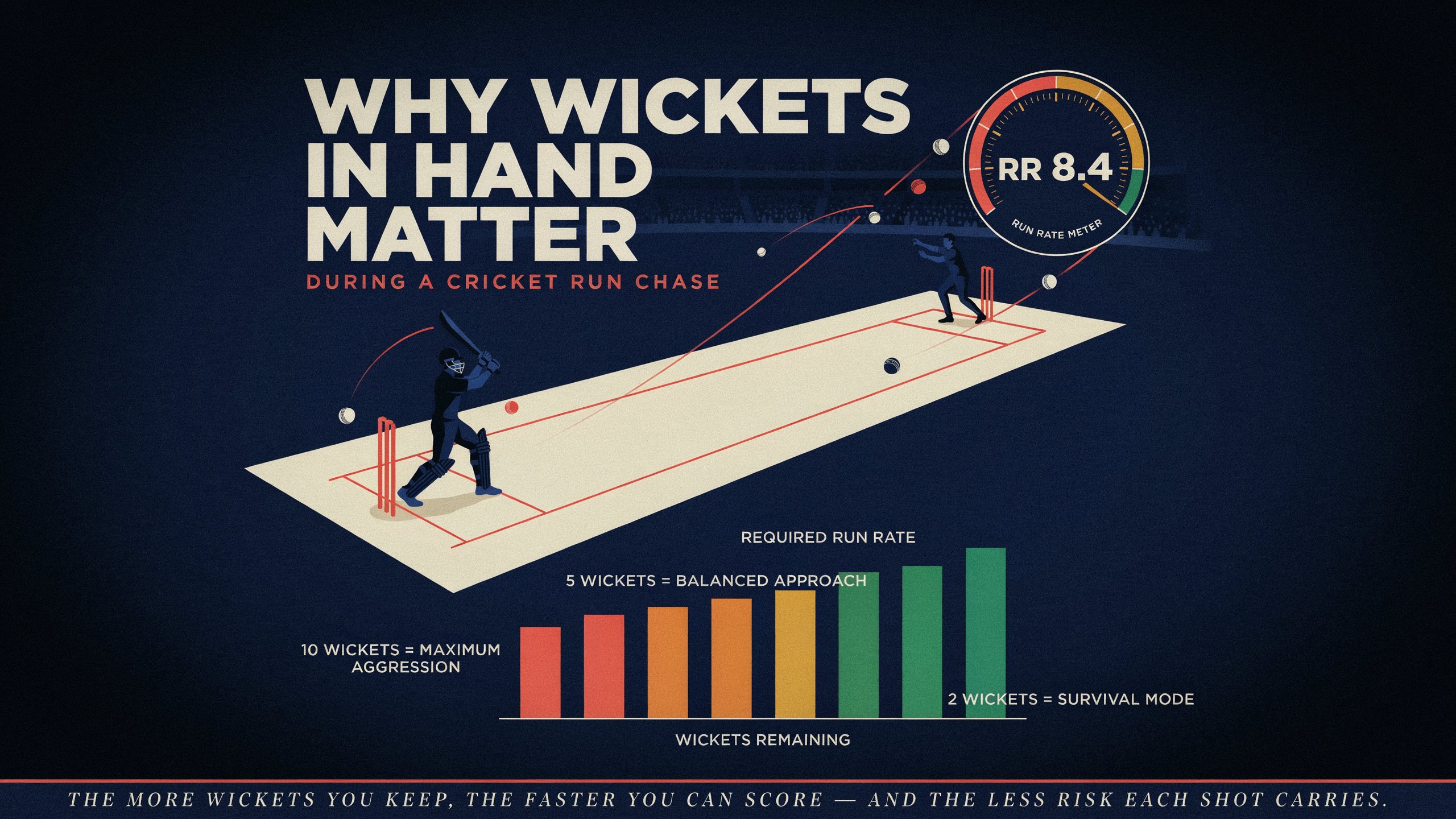
Why Wickets in Hand Matter During a Cricket Run Chase
In cricket, a successful run chase is not determined only by the number of runs scored. The number of wickets remaining can be just as important because wickets represent the batting team’s available resources. A team with several wickets in hand has more flexibility to manage the required run rate, absorb difficult periods, and attack when conditions become favorable.
Understanding why wickets in hand matter during a cricket run chase helps explain many strategic decisions made by batters, captains, and coaches. It also provides a clearer way to evaluate whether a chasing team is genuinely in control of a match.
What Do Wickets in Hand Mean During a Run Chase?
Wickets in hand refer to the number of batting dismissals a team has available while chasing a target. For example, if a team is chasing 180 runs and has lost only two wickets, it still has eight wickets available. If the same team has lost seven wickets, only three wickets remain.
The difference is strategically significant. Wickets provide additional batting resources, while losing them reduces the number of specialist batters available and can make it harder to maintain an aggressive scoring rate.
A chase therefore involves managing two key resources:
- Runs required
- Wickets remaining
The relationship between these resources changes throughout the innings.
Why Are Wickets Important in a Cricket Run Chase?
Wickets matter because they determine how much batting depth a team has available. A team that preserves wickets can take calculated risks later in the innings. It can also recover from a slow start because established batters remain at the crease.
For example, suppose a team needs 60 runs from the final 10 overs. If it has eight wickets in hand, the batting side can attack aggressively without being overly concerned about one or two dismissals.
If it needs the same 60 runs with only two wickets remaining, the situation is considerably more difficult. This is why wickets in hand are often considered a form of strategic insurance during a chase.
How Do Wickets in Hand Influence Run Rate?
Wickets in hand give batters greater freedom to increase the scoring rate. A batter can attempt a high risk shot because other batters are still available if the attempt results in a dismissal.
Consider these situations:
| Situation | Runs Required | Wickets Remaining | Strategic Position |
| A | 80 from 12 overs | 8 | Strong flexibility |
| B | 80 from 12 overs | 3 | Considerably more pressure |
| C | 45 from 5 overs | 7 | High attacking potential |
| D | 45 from 5 overs | 2 | High dismissal risk |
The required run rate alone does not explain these situations. Wickets remaining provide additional context about whether the batting team can realistically sustain the required scoring rate.
How Does Losing Early Wickets Change a Chase?
Early wickets can fundamentally alter the strategy of a chasing team. When two or three wickets fall during the early stages, the remaining batters may need to reduce their attacking intent. Instead of immediately targeting boundaries, they may focus on rebuilding the innings through singles, twos, and controlled boundary opportunities.
For users following changing match situations and exploring cricket betting markets, a World7777 sports book id can provide access to an online sports betting platform where cricket related match markets and selections may be available.
A period of cautious batting can cause the required run rate to increase. Once that happens, the team may eventually need to take greater risks, creating another opportunity for the bowling side.
Therefore, an early wicket can influence both available resources and scoring pressure.
Why Is Wicket Preservation Important in Limited Overs Cricket?
Limited overs cricket places a fixed limit on the number of deliveries available. This makes resource management particularly important.
In the early part of a chase, a batting team generally has more time to recover from a slow scoring period. Preserving wickets during this phase can allow the team to increase its scoring rate later.
The basic strategic idea is simple:
Use the available overs efficiently while protecting enough wickets to attack later.
This approach varies depending on the format, pitch, target, and strength of the batting lineup. A T20 chase provides fewer deliveries for recovery than an ODI chase, so the balance between scoring quickly and preserving wickets can be different.
How Do Wickets in Hand Affect Batting Risk?
Risk management is one of the most important reasons wickets matter during a run chase.
- More wickets allow greater aggression: Batters can take calculated risks because several batting options remain available if a dismissal occurs.
- Fewer wickets increase pressure: When only a few wickets remain, every dismissal becomes more costly.
- Established batters provide flexibility: Experienced players can often attack difficult bowling matchups while maintaining control.
- Wickets influence shot selection: With plenty of wickets available, batters may attempt more boundary focused shots. With fewer wickets, they may prefer lower risk scoring options.
- Aggression must be balanced with the run rate: Preserving wickets is not enough if the required run rate continues to increase.
The goal is to manage both wickets and runs rather than focusing entirely on one resource.
Can Wickets in Hand Compensate for a Rising Required Run Rate?
Sometimes, but not indefinitely. A team with several wickets remaining can potentially increase its scoring rate during the later stages of an innings. Powerful middle order and lower order batters may be able to target boundaries when favorable opportunities appear.
For instance, a team might require 90 runs from 12 overs while having eight wickets available. Although the required rate may be demanding, the batting side still has enough resources to attack.
If the same target is required with only three wickets remaining, the situation becomes much more difficult. Wickets can provide the capacity to respond to a rising required run rate, but they cannot eliminate the importance of time and scoring requirements.
How Do Wickets Influence the Final Overs?
The final overs of a limited overs chase often reveal the value of wickets in hand most clearly. With wickets available, batters can target boundaries, attempt aggressive running between the wickets, and attack favorable matchups.
Captains may also find it harder to defend a total when the chasing team has several wickets remaining because the batting side can continue taking calculated risks.
When wickets are low, the bowling team can exploit the situation differently. Bowlers may use defensive fields, target the stumps, and force remaining batters to take higher risk options.
The final overs therefore involve a combination of:
- Required runs
- Remaining deliveries
- Wickets available
- Batting quality
- Bowling quality
- Match conditions
Why Do Partnerships Matter in a Run Chase?
Wickets in hand become more valuable when two batters build a steady partnership. A strong partnership helps the chasing team manage pressure, set smaller scoring targets, and maintain a consistent run rate instead of focusing only on the total runs remaining.
Partnerships also reduce the impact of losing one batter. If one player is dismissed while the other remains settled, the new batter can build an innings alongside an established partner.
This makes wicket preservation an important part of maintaining control during a chase.
How Does Batting Depth Affect the Value of Wickets?
Not every wicket has the same strategic value. A team with a strong batting lineup may be better equipped to recover after losing wickets than a team whose lower order contains weaker batters.
For example, losing a top order batter when several quality middle order players remain may be manageable. Losing a set batter when only tail end players remain can be much more damaging.
Therefore, wickets in hand should always be considered alongside batting depth. The number of wickets remaining provides useful information, but the identity and quality of the remaining batters provide additional context.
How Do Wickets Shape Cricket Match Strategy?
Wickets affect decisions throughout a chase.
Powerplay Strategy
Teams may attempt to score quickly during fielding restrictions while avoiding unnecessary dismissals.
Middle Overs Strategy
Batters often focus on maintaining momentum, building partnerships, and identifying favorable bowling matchups.
Death Overs Strategy
Teams with wickets available can generally take more aggressive risks because fewer overs remain and boundary scoring becomes increasingly important.
The precise strategy depends on match conditions, but the principle remains consistent: wickets influence the amount of risk a team can reasonably take.
Why Is the Required Run Rate Not Enough?
The required run rate is one of the most visible statistics in a chase, but it should not be considered in isolation.
Imagine two teams both require 50 runs from five overs:
- Team A has seven wickets remaining.
- Team B has two wickets remaining.
Their required run rates are identical, but their practical situations are very different. Team A has several batters who can attack and recover from mistakes. Team B has far less room for error.
This demonstrates why a complete assessment of a chase should consider both scoring requirements and remaining wickets.
How Can Analysts Evaluate Wickets in Hand?
A useful analysis should consider several factors together rather than treating wickets as a standalone statistic.
Key factors include:
- Runs required
- Balls remaining
- Wickets remaining
- Current scoring rate
- Required run rate
- Batting depth
- Quality of remaining batters
- Bowling resources
- Pitch behavior
- Boundary dimensions
- Weather and match conditions
This broader approach provides a more realistic assessment of the chasing team’s position.
Do Wickets in Hand Guarantee a Successful Chase?
No. Wickets in hand improve flexibility, but they do not guarantee victory. A team can have eight wickets remaining and still lose because the required run rate becomes too high. Similarly, a team can lose several early wickets and still complete a successful chase through an exceptional partnership.
Cricket contains too many variables for one statistic to determine the outcome. Wickets should therefore be understood as a strategic resource rather than a prediction of victory.
Wickets in Hand and Modern Cricket Analysis
Modern cricket analysis increasingly evaluates wickets alongside run rate, scoring patterns, matchups, and expected outcomes. This is useful because traditional scorecards can sometimes hide the strategic context of an innings.
A score of 100 for two wickets can represent a strong position in one chase but a poor position in another. The difference may depend on the target, overs remaining, pitch conditions, and quality of the remaining batting lineup.
Wickets therefore provide an important indication of how much flexibility remains.
Conclusion
Wickets in hand matter during a cricket run chase because they represent the batting team’s remaining resources and influence how aggressively batters can approach the target. A team with several wickets available generally has greater flexibility to absorb setbacks, build partnerships, and accelerate when necessary.
However, wickets cannot be considered separately from the required run rate and remaining deliveries. The strongest assessment of a chase combines runs required, balls remaining, wickets in hand, batting depth, bowling quality, and match conditions.
Ultimately, successful chasing is about managing resources effectively. Runs determine what must be achieved, while wickets determine how much freedom a team has to achieve it.